
Prototype in a day: co-designing the future of health and athlete technology
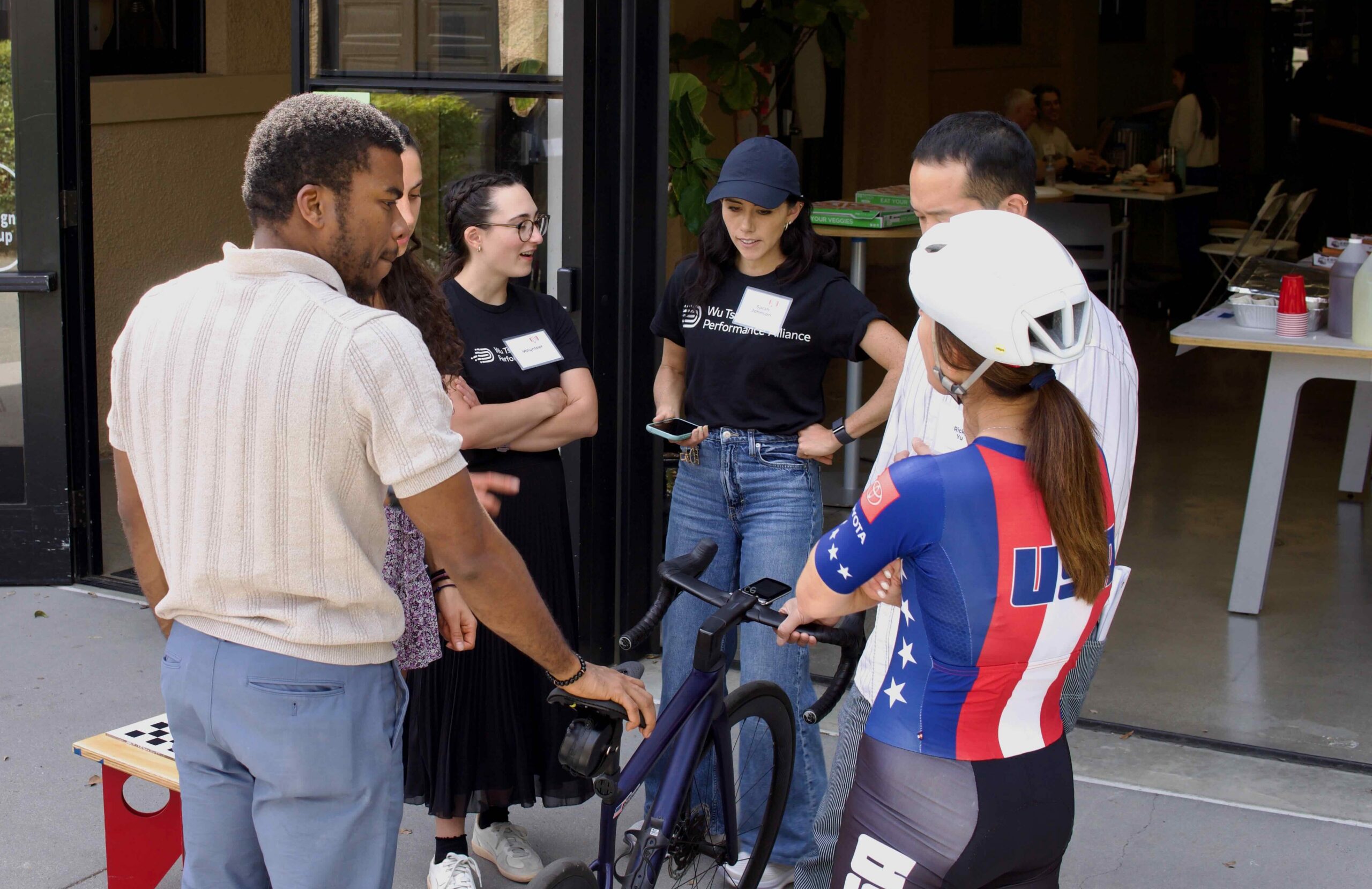
One CHAT team built a personalized engine powered by a large language model to give athletes real-time feedback. Left to right: Emeka John Amamdikwa, Alexa Eichelmann, Kayla Russell-Bertucci, Sarah Johnson, Ricky Yu, and Andrea Cherniak.
A smart rowing glove. A mirrored robotic arm. An adaptive wedge for a prosthetic limb. These were just a few of the prototypes built at this year’s CHAT (Co-design for Health and Athlete Technology) workshop on April 18, 2026, each one designed with the person who would use it. That ethos is what CHAT is built on: designing solutions with end-users, not just for them.
Supported by the Wu Tsai Human Performance Alliance at Stanford and the NIH-funded FAIR Center, CHAT brought together over 80 students, engineers, clinicians, and most importantly 12 mobility champions — individuals navigating lived experiences like stroke recovery or prosthesis use — to co-design solutions to real-world challenges.
“I enjoyed working closely with our mobility champion to understand his goals and co-create a solution around independence,” said a CHAT participant. “The combination of personal storytelling and hands-on prototyping made it incredibly meaningful.”
The highlight of the workshop was seeing teams ideate and prototype in real time. Each team included the end-user who would use these devices, allowing the team to discover nuanced challenges and design more targeted solutions.
Here is a look at a few projects from the event:
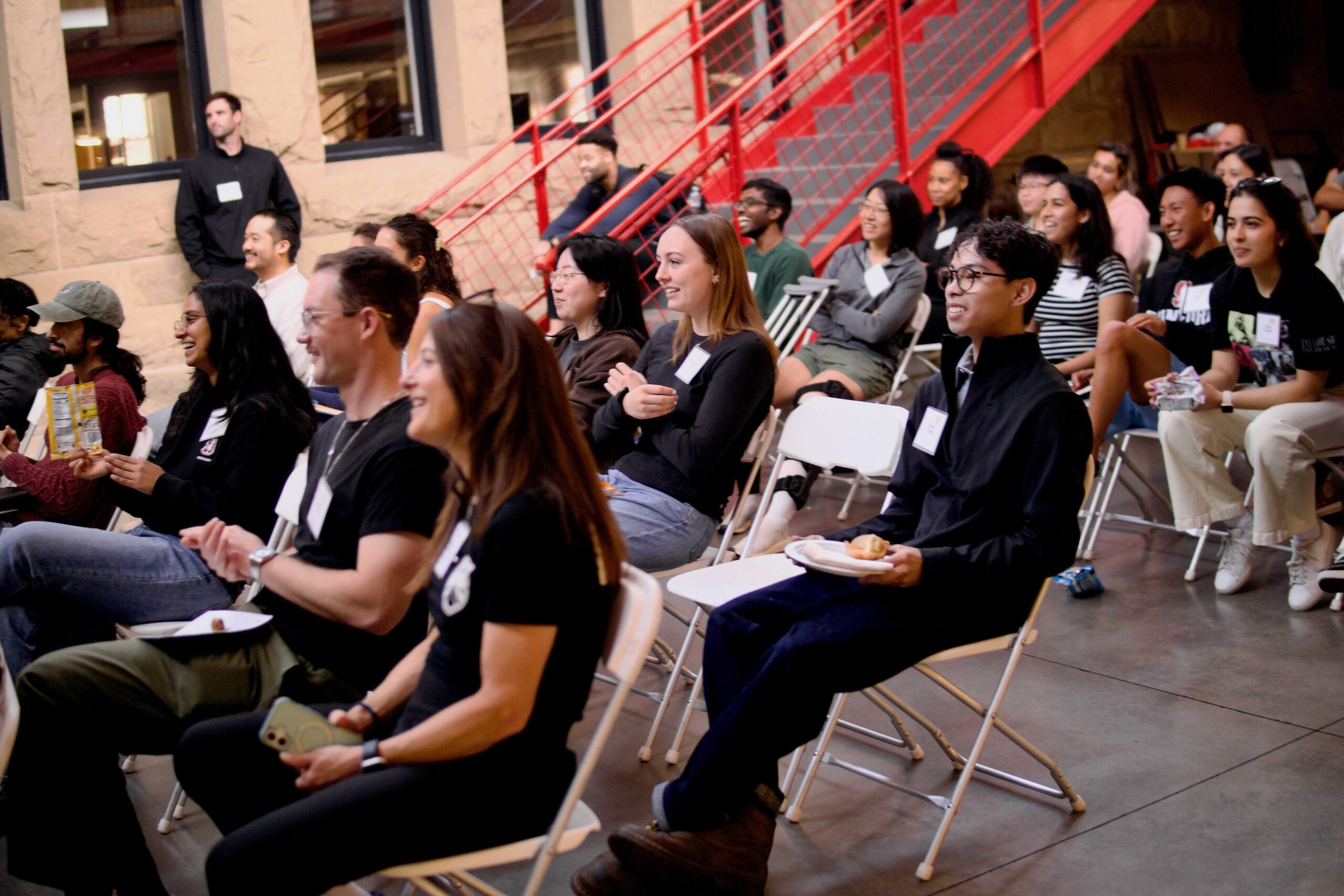
CHAT participants gather to watch the final prototype presentations.
Team 1: Intelli-Row
The Challenge: How might we help Ajay Shenoy, a para-rower, safely attach to and release from rowing oars to increase independence on the water? Currently, para-rowers can remain attached to their oars for hours on the open waters, but it comes at the cost of simple freedoms like scratching an itch or adjusting a hat. To do so, they must interrupt their training, exit the water, and detach from the oars.
The Solution: The team developed Intelli-Row, a smart rowing glove that uses button-activated fiber wires to assist the movement of individual fingers. By helping Shenoy grip and release the oars, the design offers greater autonomy and comfort on the water.

Ajay Shenoy and Michelle Joyce (left to right) prototype Intelli-Row.
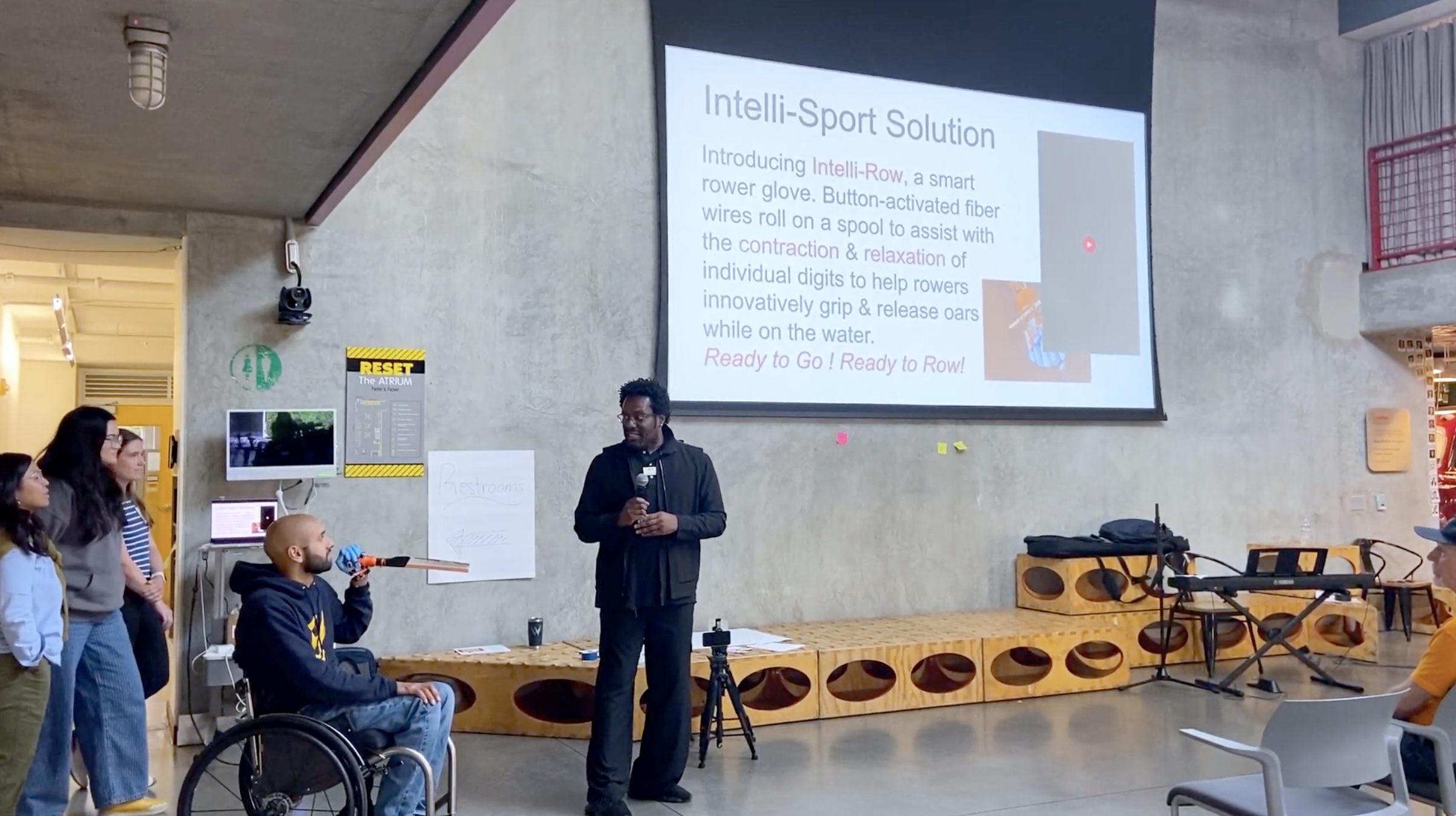
The Intelli-Row team presents their final design. Left to right: Nathalie Macalma-Torio, Aidai Boobekova, Michelle Joyce, Ajay Shenoy, Andrew Oye.
Team 2: Mirrored Robotic Arm System
The Challenge: How can we help restore arm function for stroke survivors? For their champion, Craig Smith, the challenge was not only mechanical recovery, but restoring his independence through a solution he could operate on his own.
The Solution: The team designed a lightweight, real-time bilateral motor mirroring system. As Smith moves his healthy left arm, the device mirrors that motion to guide movement in his right arm. Rooted in neuroplasticity research, the design aligns with the critical 3-to-6-month window of early intervention, helping forge new neural pathways toward healing.
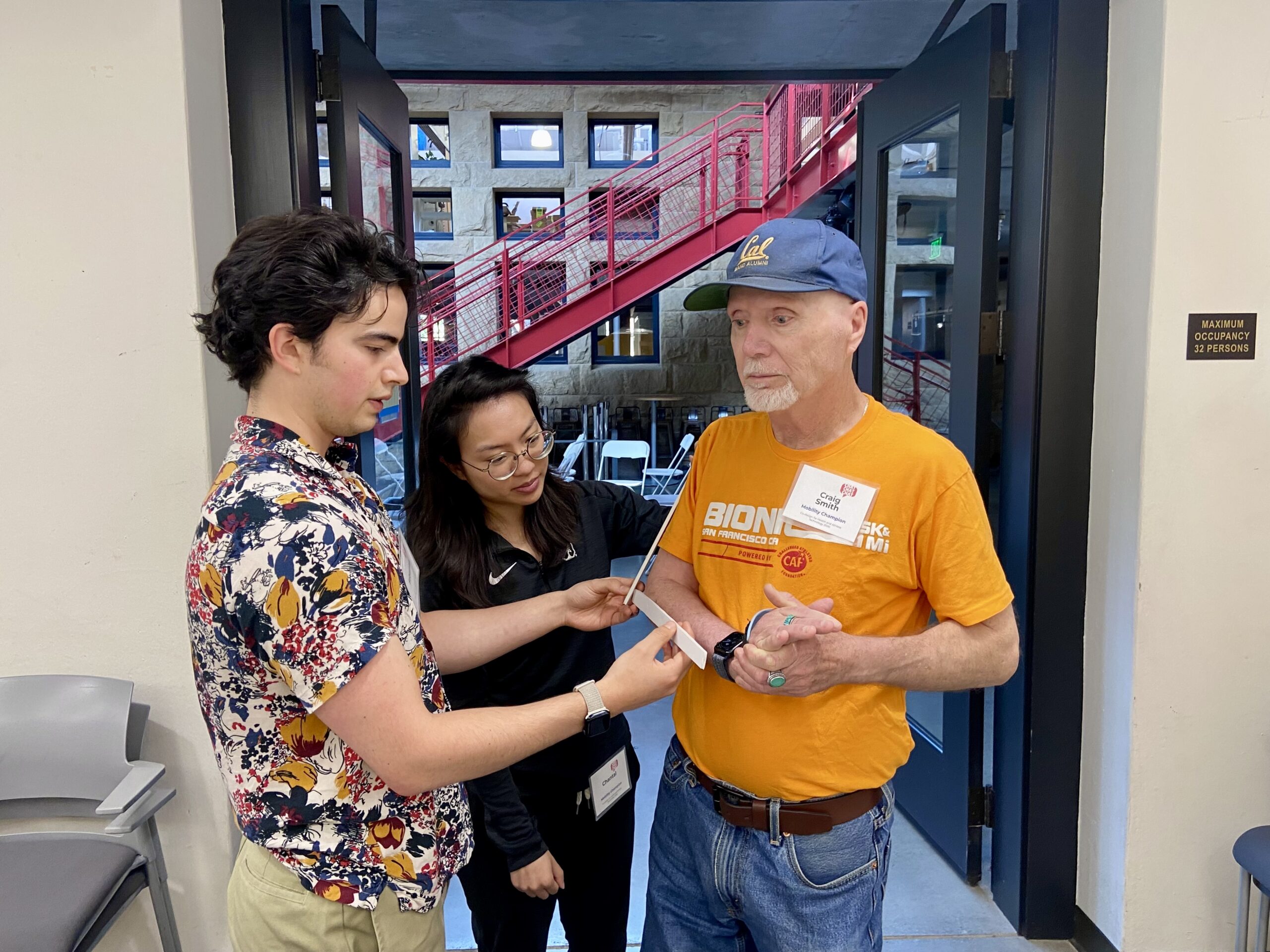
Sebastian Esteva and Chantal Nguyen (left to right) prototype their mirrored robotic arm on Craig Smith.
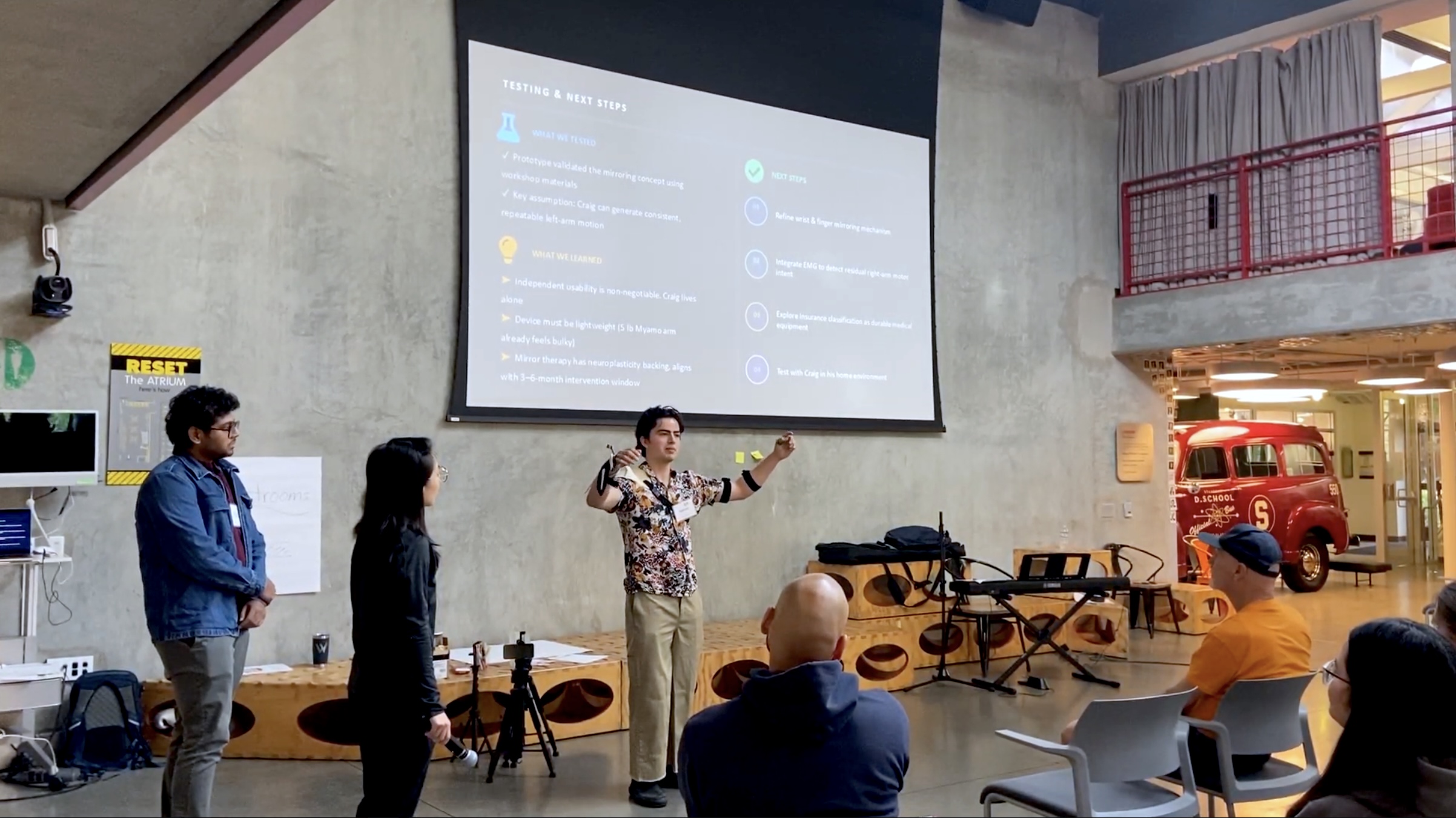
Abhay Chakra Sadineni, Chantal Nguyen, and Sebastian Esteva (left to right) present their final design.
Team 3: Adaptive Incline Wedge
The Challenge: How might we empower Geoff Faulker, who uses a prosthetic limb, to comfortably walk on hill inclines? For Faulker, a landscape photographer, even a simple hill can become an exhausting obstacle.
The Solution: The team designed a wedge-shaped attachment for Faulker’s prosthetic that adjusts to the angle of a hill. Easily attachable and removable, the device also includes a treaded bottom for traction and stability on uneven terrain.
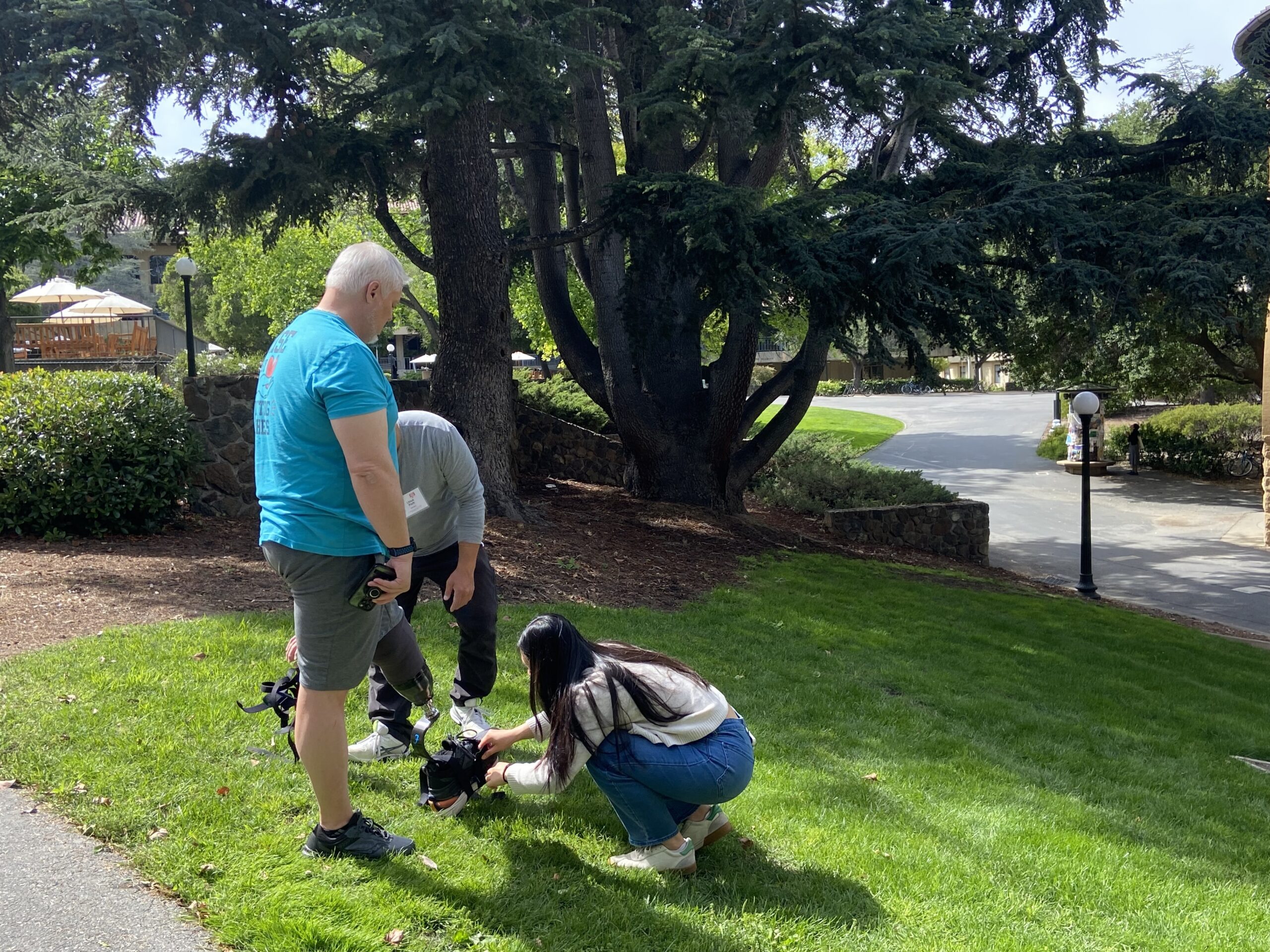
Geoff Faulker, Linus Park, and Audrey Lin (left to right) design their incline wedge prototype.
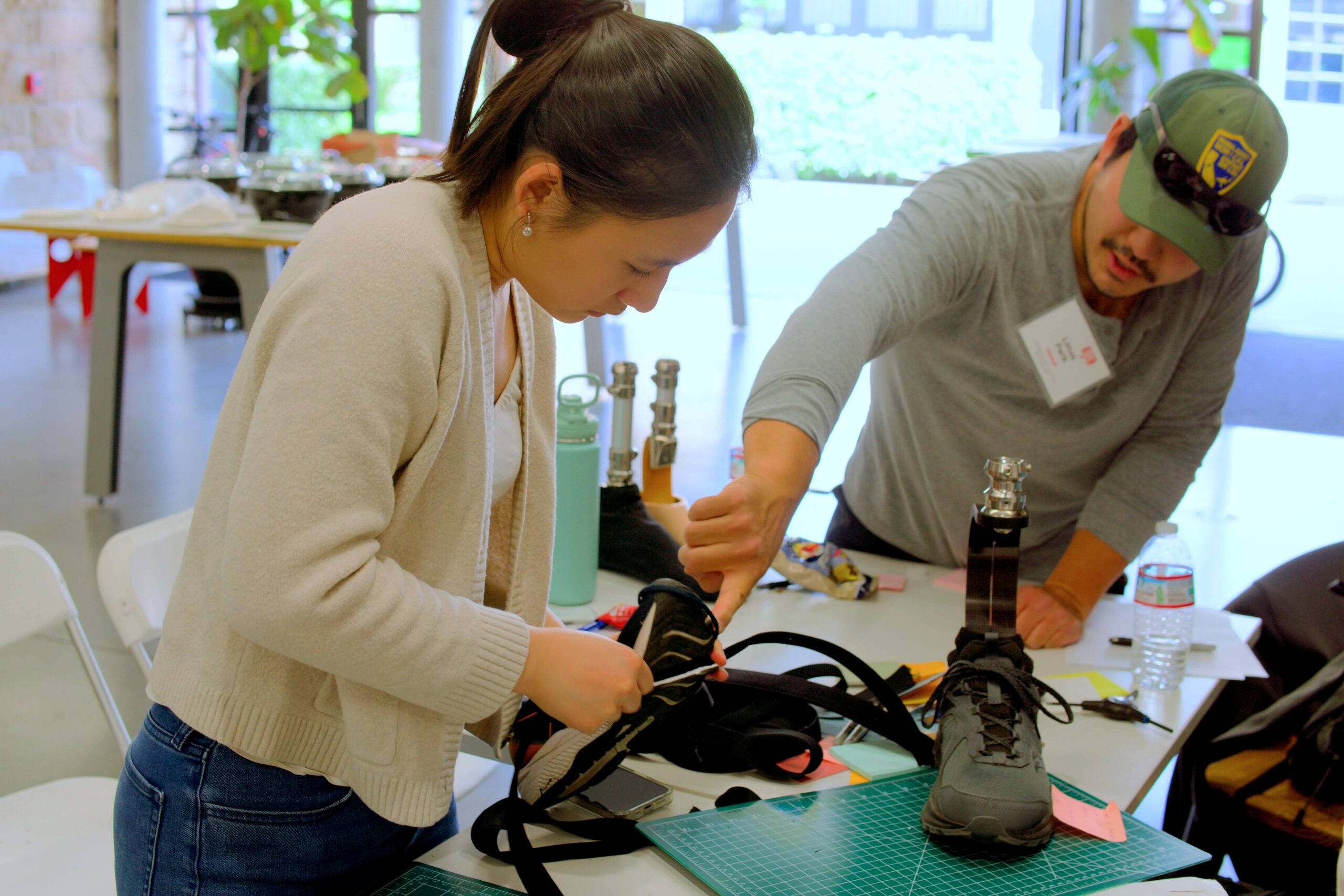
Audrey Lin and Linus Park (left to right) design the incline wedge to empower Geoff Faulker to walk uphill comfortably.
“I came away with such a better understanding of design thinking, and a better map for translating an idea into action/a tangible solution/prototype,” wrote another CHAT participant. “Would 100% attend the next event, and will be recommending/advertising to my network.”
CHAT 2026 demonstrated what is possible when human-centered design meets engineering innovation. By placing lived experiences at the center of the process, the workshop showed how the future of health and athlete technology depends on collaboration and inclusion.
Thank you to workshop leaders Krithika Swaminathan and Hannah O’Day for organizing the workshop.
Latest News

October 5, 2026
The exercise showdown: HIIT vs endurance training? A Stanford lab maps the molecular changes
September 8, 2026
A wearable device tracked over 42,000 menstrual cycles. Here’s what researchers found
August 24, 2026
Register for Wu Tsai Human Performance Alliance 2026 Research Symposium
Get Engaged
We invite faculty, students, staff, alumni, friends, and external organizations to participate in the Wu Tsai Human Performance Alliance at Stanford.