
How training one leg could reveal insights into muscle memory
By Kristy Hamilton
In this Behind the Research Q&A Series, we visit Malene Lindholm at Stanford University where she explains how training one leg could reveal whether our muscles hold a molecular memory of past exercise.

Dr. Malene Lindholm
Dr. Malene Lindholm is a senior research engineer and Director of the human Molecular Athlete Moonshot for the Wu Tsai Human Performance Alliance at Stanford.
For three months, a group of men and women strapped a boot to one foot, hooked it to a bike wheel, and trained just one leg. Nine months later, they came back and trained both. This provided Malene Lindholm a rare opportunity: a living comparison, inside the same body, between a muscle with months of training and a similar muscle with none.
The question she’s after: when you take time off from exercising, does your body hold onto any molecular memory of the work you put in? To find out, she’s analyzing biopsies from those muscles for gene activity, protein levels, and the epigenome, or chemical markers on the DNA that influence how genes behave without changing the code itself.
The following responses are the researcher’s own words, edited and condensed for clarity.
What’s the central question your current research is trying to answer?
We are interested in whether there is any memory effect of training. Are there any remaining epigenetic effects after this long detraining? Is it beneficial somehow to have trained before?
For example, if you were active when you were a child and then you haven’t trained for ten years and you then decide to become physically active again, do you have any benefit from that within your muscle? Is there any intrinsic memory of that previous training?

Neuromuscular memory involves changes to the nervous system and lets the body remember how to perform a skill, like a gymnast’s routine. Malene Lindholm is searching for a different kind of memory: epigenetic memory. She wonders if there is a molecular record of past training in muscle cells that alters how a person’s DNA in those cells responds to additional training. Canva Pro Images
Is muscle memory a real thing, or is it still an open question?
There’s neuromuscular memory: If you’ve done something, especially more technical movements like gymnastics, that’s very much muscle memory. You just keep practicing until you learn the movement. Even if your muscles deteriorate from six weeks of illness, the memory of how to activate them for that movement remains. I think that’s the same for people who’ve done strength training.
But then there’s the question: is there also something within the muscle itself that kickstarts gene activation faster? That’s what we’re trying to find out.

“If you were active when you were a child and then you haven’t trained for ten years,… do you have any benefit from that within your muscle? Is there any intrinsic memory of that previous training?”
This is a unique experimental set-up. Why not just compare two different people?
When comparing two people, it’s hard to tell if your findings come from the intervention itself or from differences in genetics, environmental exposures, and other stimuli throughout life. These exposures can alter our genes’ behavior through the epigenome. Even identical twins show increasingly different epigenomes as they age, just from living different lives, even as their genetics are the same.
So we used a one-leg design in the same person: both legs experience the same diet, the same sleep, the same sun exposure, the same walking around and doing all the other things. We could isolate the effect of training by just training the one leg. It was a way to make sure that each individual was their own experimental control.
We took biopsies before and after training from both legs, so we can sort of subtract the effect in the untrained leg from the effect in the trained leg.
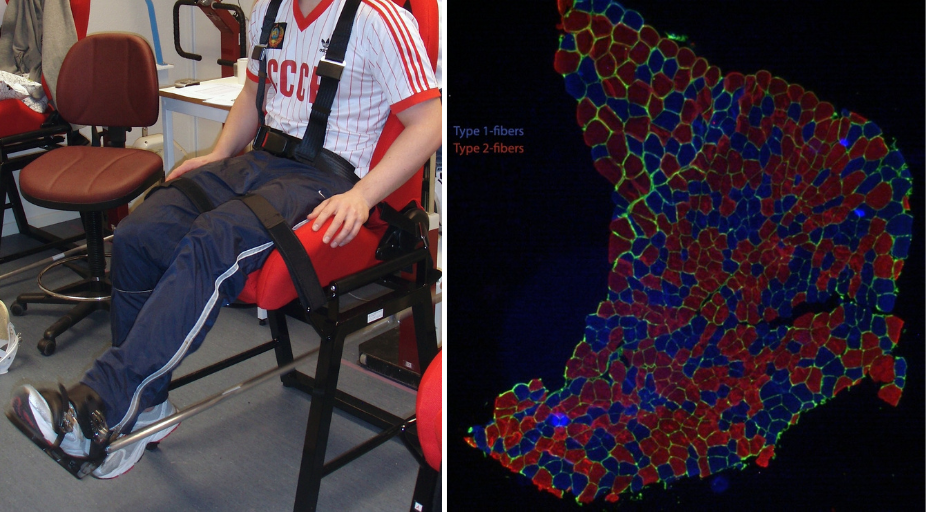
A participant (left) trains one leg using a boot attached to a bike wheel, while the other leg remains untrained as a control. Image credit: Malene Lindholm. Right: A cross-section of human muscle tissue stained to show the two primary muscle fiber types: type I fibers (blue), which support endurance and aerobic activity, and type II fibers (red), which generate faster, more powerful movements. Image credit: Malene Lindholm
What did the actual training look like?
People came in 4 times a week for 3 months. We were training people from 6am to 10pm. What’s nice about the one-leg design is that participants were seated, so they could sit and study, or watch a movie at the same time.
The setup looked like one of those snowboard boots. You strapped your foot in, and it was connected by a metal rod to a bike wheel that you pulled around with your foot. The resistance continuously increased as they got better. They trained for 45 minutes and kicked 60 times per minute. It’s a lot of training.
These people came back nine months later and trained both legs in the exact same way for another three months. That meant when they came back, they had one previously untrained leg and one previously trained leg.
What are you looking for in the muscle biopsies?
Our goal is to map the epigenetics alongside gene activity at all these time points. We’ve also recently run proteomics to look at the proteins in the muscle. The proteins are the functional molecules, so will provide another level of understanding about what is happening. The aim is to build a molecular map of training, detraining, and retraining.
What’s unique about this study is that we have three identical training interventions in the same person. So we can see how consistent the effects are within an individual, and whether the two legs differ.
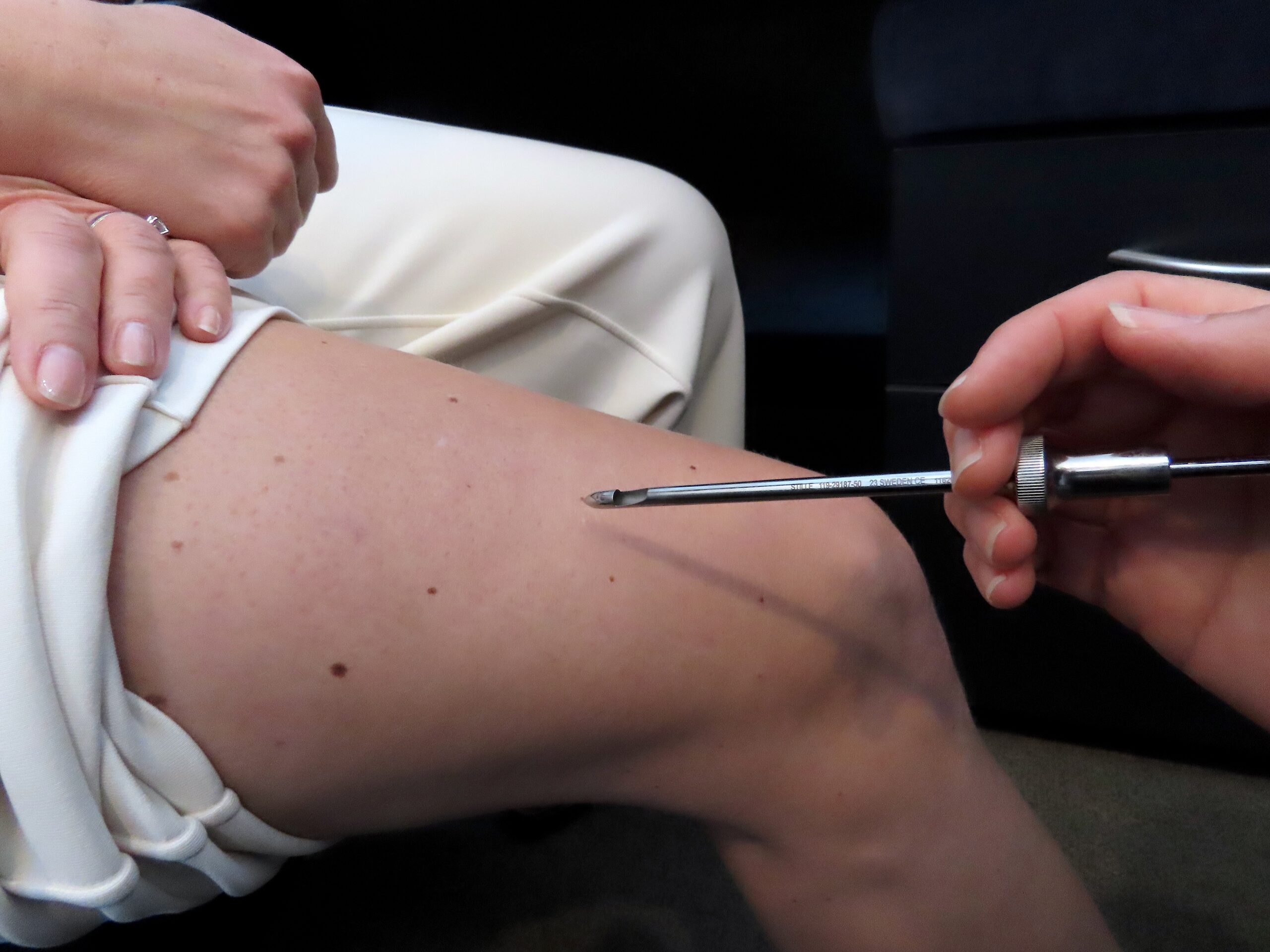
Demo biopsy for illustration purposes only. Lindholm’s team takes muscle biopsies to analyze DNA methylation, gene activity, and protein levels to build a molecular map of how muscles respond to training, detraining, and retraining.
You’ve studied these same biopsies before. How has technology changed what’s possible here?
We did a very basic epigenetic analysis during the first training period. We looked at DNA methylation of 450,000 sites across the genome. Now, we’re looking at the whole genome — three billion base pairs, out of which ~28 million are so-called CpG sites that can be methylated or not. That technique was not available at that time for our previous studies (in Epigenetics and PLoS Genetics). Now we can look in a more unbiased way and hopefully find the sites that are relevant for muscle and for training, and potentially for memory.
Malene Lindholm is a Wu Tsai Human Performance Alliance @Stanford Agility Project Awardee, studying the epigenetic drivers of human skeletal muscle adaptation to training, detraining and retraining.
Latest News

September 8, 2026
A wearable device tracked over 42,000 menstrual cycles. Here’s what researchers found

August 24, 2026
Register for Wu Tsai Human Performance Alliance 2026 Research Symposium

July 8, 2026
Are your hands too small or is the piano too big?
Get Engaged
We invite faculty, students, staff, alumni, friends, and external organizations to participate in the Wu Tsai Human Performance Alliance at Stanford.