
A wearable device tracked over 42,000 menstrual cycles. Here’s what researchers found
Drawing on 1.2 million days of wearable data, researchers mapped the daily physiology of the menstrual cycle at unprecedented scale, specifically exploring its relationship with sleep.
By Kristy Hamilton
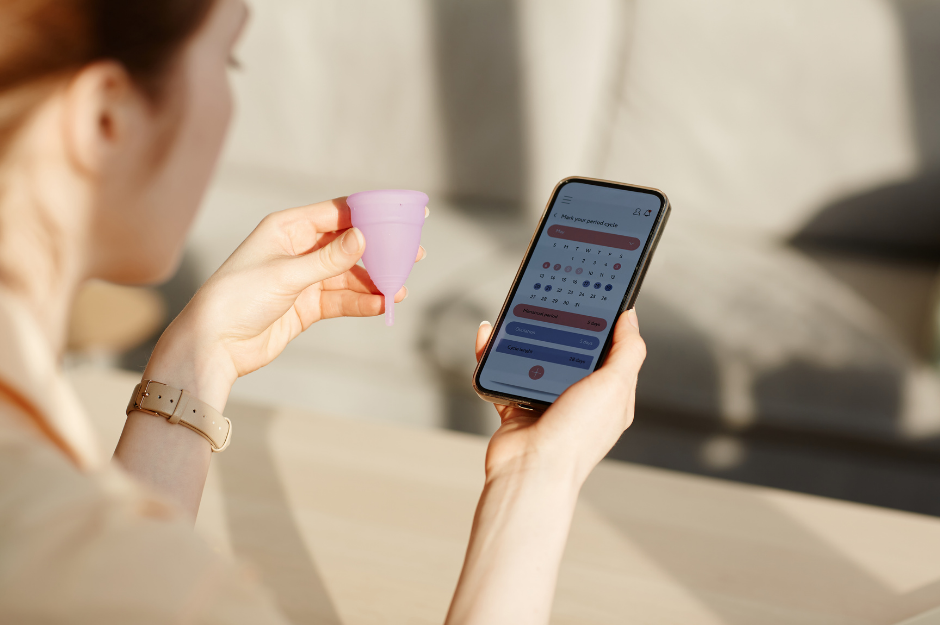
Canva Pro Images
The average woman has about 450 menstrual cycles in a lifetime, yet what happens across the menstrual cycle has rarely been charted in detail. A new study, published in npj Digital Medicine by researchers at Stanford University and WHOOP, is filling that gap by drawing on wrist tracker data from over 42,000 cycles spanning 1.2 million days.
It is, the authors note, the first daily-resolution profile of resting heart rate, heart rate variability, respiratory rate, skin temperature, and blood oxygen across both ages and cycle lengths.
“Our heart rate, our temperature, and our respiration rate are vital signs,” said Jennifer Hicks, senior author and Executive Director of the Wu Tsai Human Performance Alliance at Stanford, “and they are used by doctors to understand our health, by athletes and coaches to monitor training, and by researchers to study new treatments and training regimes. It was astounding to me that we didn’t know how they change across the menstrual cycle for women of different ages and with different cycle lengths.”
With the 1.2 million days of data, the team could carefully quantify these relationships to better advise women and enable more rigorous experiments that account for menstrual cycle differences.

How many women participated?
More than 2,500 women contributed their data to this study, sharing both the biometrics from their wrist-worn devices and recording their periods on their smartphones.
For example, say you wake up and your smartwatch says your resting heart rate is up and your heart rate variability down. The device seems to say you’re not recovered, so you swap the hard workout for an easy one. But is that accurate?
Several factors drive those numbers, including sleep and where you are in your menstrual cycle. A single reading can’t tell you which. Sorting out those overlapping signals is what this study set out to do, starting with sleep and the menstrual cycle.
The researchers found some associations between the two. Women who got less than about 7.3 hours of sleep a night tended to have more irregular cycles. Sleep consistency mattered too. A woman whose sleep bounced between 6 and 8 hours across a week was more likely to have an irregular cycle than one who slept a steady seven hours per night.
Image courtesy of WHOOP
When it comes to sleep loss and its impact on biometric signals, though, losing sleep costs the same no matter where in the cycle it occurred: before a period, during it, or after.
The researchers observed that in a week with nearly 5 hours less sleep, heart rate variability dropped nearly 3 percent. This drop was the same regardless of whether the sleep loss occurred during and right after menstruation (the follicular phase), when the resting heart rate is typically lower, or in the luteal phase (just before the next period).
That same sleep loss was also associated with a climb in breathing rate and a dip in blood oxygen. Resting heart rate rose on average by 1.2 percent. The relationship runs on a sliding scale: the less women slept, the higher their resting heart rate
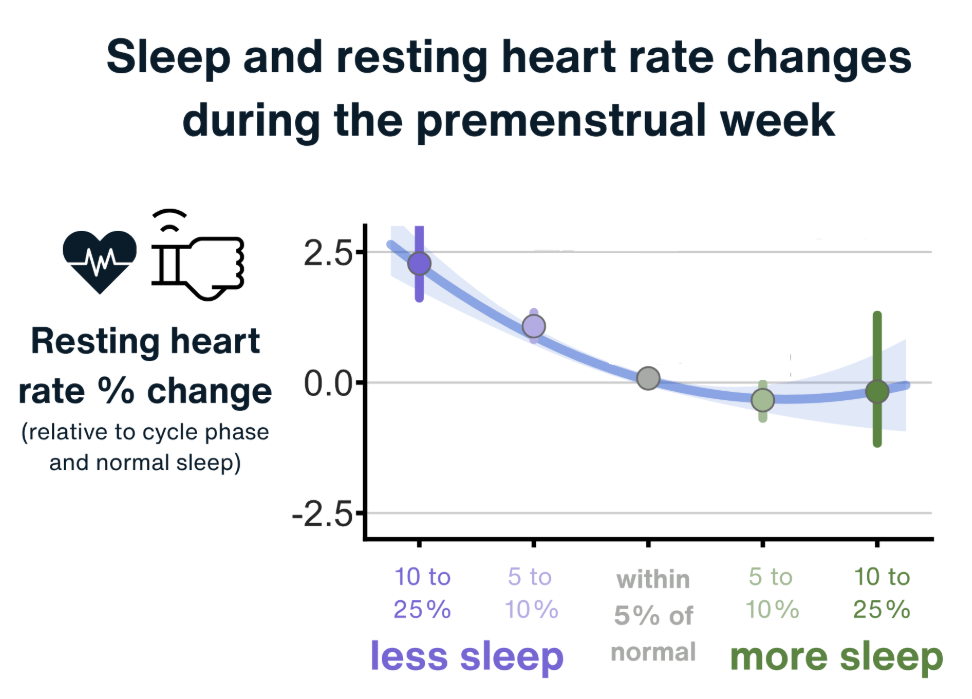
Adapted from Figure 4c in Gonzalez, O’Day et al., 2026. Changes in resting heart rate were similar across the menstrual and postmenstrual weeks.
“A popular trend is to plan training based on scores derived from heart rate data,” said co-first author Alexander Gonzalez, Scientific Project Manager and researcher at the Wu Tsai Human Performance Alliance at Stanford. “What individuals may not recognize is that there are many reasons their heart rate might change. It can simply reflect a poor night’s sleep or where they are in their cycle.”
Acting on those signals without knowing what’s behind them may do more harm than good. This study helps fill in the why.
The physiological impact of lost sleep may be consistent across the cycle, but the amount of sleep lost isn’t. Women tended to lose the most sleep in the week before a period, though not all of them; some actually slept more then.
The full analysis is open source
The code used for this research is freely available on GitHub and walks through how each figure was produced. There is also a companion project website.
The biometrics showed variation with menstrual cycle length, too: A woman with longer cycles, around 34 days, saw bigger swings in heart rate, heart rate variability, and breathing rate than women with shorter cycles. However, that trend differed with age. A 44-year-old’s heart rate varied less across her cycle than a 24-year-old’s did, even when their cycles were the same length.
These differences are part of what makes baselines useful. They let individuals and researchers read a given measurement against what’s typical for a particular age and cycle length.
“What’s exciting is that this study offers a framework for using biometric data, collected at a scale larger than ever, to reveal population-level trends that can inform how we understand and improve health and performance,” said co-first author Johanna O’Day, a Wu Tsai Human Performance Alliance researcher at Stanford University. She added she’s eager to see “how the field builds upon this as we amass more data across the cycle.”

“What’s exciting is that this study offers a framework for using biometric data, collected at a scale larger than ever, to reveal population-level trends.”
– Johanna O’Day
The authors highlight a few caveats. The women in this study are not representative of American women. WHOOP users tend to be more active, more health-conscious, and wealthier than the average woman. The study left out women on hormonal birth control, those who were pregnant or perimenopausal, and those with cycles outside the 21-to-35-day range.
“This study provides valuable insights about sleep and the menstrual cycle, but has also generated many new questions to explore,” said Hicks. “As wearable sensing technology continues to advance and enable studies of thousands rather than tens of participants, we can now take the hypotheses we’ve generated and test them in future studies.”
“And in the meantime,” said Hicks, “striving for consistent and adequate sleep, as much as your life allows, is always an important goal.”
Read more: Stylist, Stanford Report
This work is part of the Wu Tsai Human Performance Alliance Female Athlete Program. Co-authors include Sarah Johnson, Jeongeun Kim, Summer Jasinski, Kristen Holmes, Scott Delp, and Jennifer Hicks
Latest News
September 8, 2026
A wearable device tracked over 42,000 menstrual cycles. Here’s what researchers found

August 24, 2026
Register for Wu Tsai Human Performance Alliance 2026 Research Symposium

July 8, 2026
Are your hands too small or is the piano too big?
Get Engaged
We invite faculty, students, staff, alumni, friends, and external organizations to participate in the Wu Tsai Human Performance Alliance at Stanford.