
Are your hands too small or is the piano too big?
Only 13 percent of women can comfortably span an octave on a standard piano. Few thought to ask whether the piano was the problem.
By Kristy Hamilton
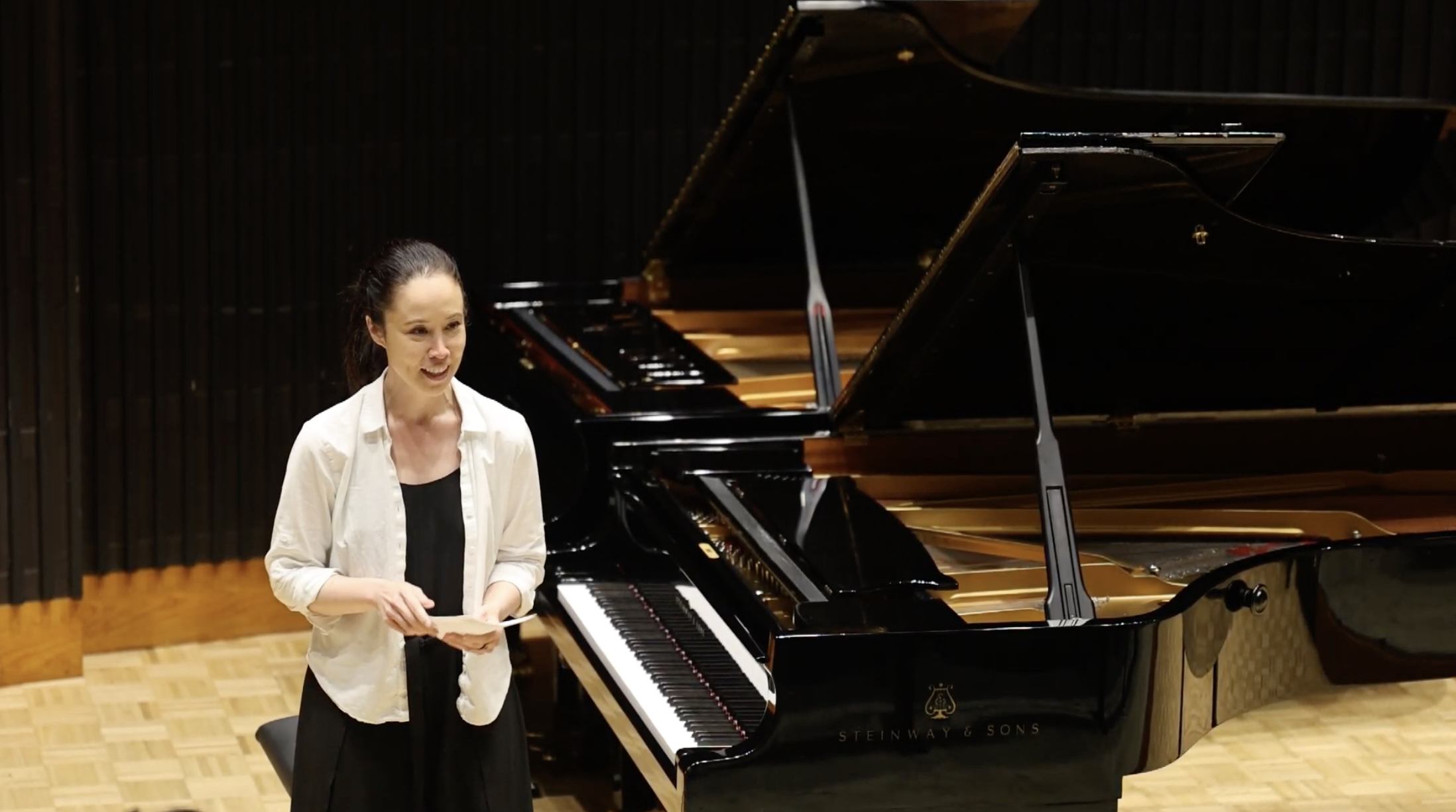
Elizabeth Schumann stands beside a narrow-keyboard piano, specially designed for smaller hands, that one of her students will perform on during her recital.
Elizabeth Schumann spent most of her life believing she was one of the lucky ones. As a concert pianist, she could reach a tenth on the keyboard (10 white keys), a span that puts her in rare company, particularly among women. It wasn’t until she sat down at a piano with narrower keys that a different picture emerged.
“When I first tried the 6.0-inch octave — which is half an inch narrower per octave than the standard keyboard — I couldn’t believe it,” she said. “I felt like I’d been wearing the wrong size shoes my entire life. I genuinely couldn’t believe how much more ergonomic everything felt.”
It turned out her impressive reach came from unusual flexibility, years of stretching to fit an instrument that was never designed for her. As a teacher, she began noticing the same pattern in her students. The ones who struggled most with tension and injury were often the ones constantly hyper-extending their fingers, straining to cover intervals the standard keyboard demanded of them. The research backed up what she was seeing: smaller-handed pianists get injured more often.
“People are blaming themselves and their bodies,” Schumann said, “instead of asking if there’s a design problem.”
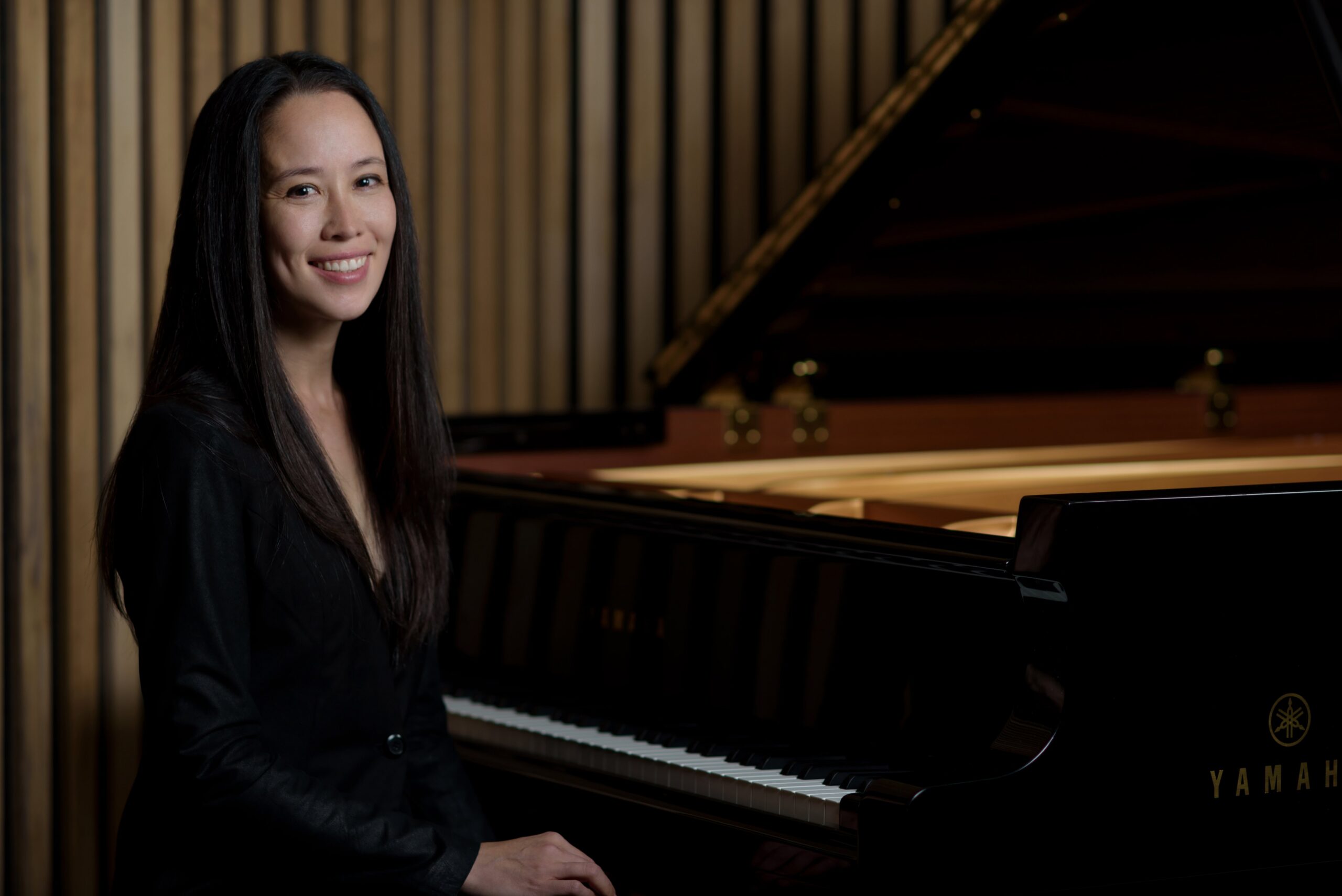
Concert pianist Elizabeth Schumann, the Billie Bennett Director of Keyboard Studies and Assistant Professor of Music at Stanford, leads the research on narrow-keyboard pianos.
Most people, including many pianists, have never thought to question the keyboard itself. The instrument’s geometry is simply taken as given. And while the idea for a narrow keyboard is not entirely new, what’s been missing is the evidence. For Schumann, that idea of a narrow keyboard became the genesis of a research study: can the fixed geometry of the piano impose a measurable performance ceiling on smaller-handed pianists?
Now, with support from the Wu Tsai Human Performance Alliance at Stanford, Schumann is getting to test her hypothesis. She designed and ran an experimental study, working with two undergraduate students to compare how pianists performed on standard and 6.0-inch octave keyboards, measuring speed, force, volume, accuracy, and reach constraint.
For Schumann, it was an opportunity to demonstrate that the arts are not just enrichment but can be a source of research and discovery. And the findings could reshape not only how pianists train but how we think about any tool or instrument built to a single standard.
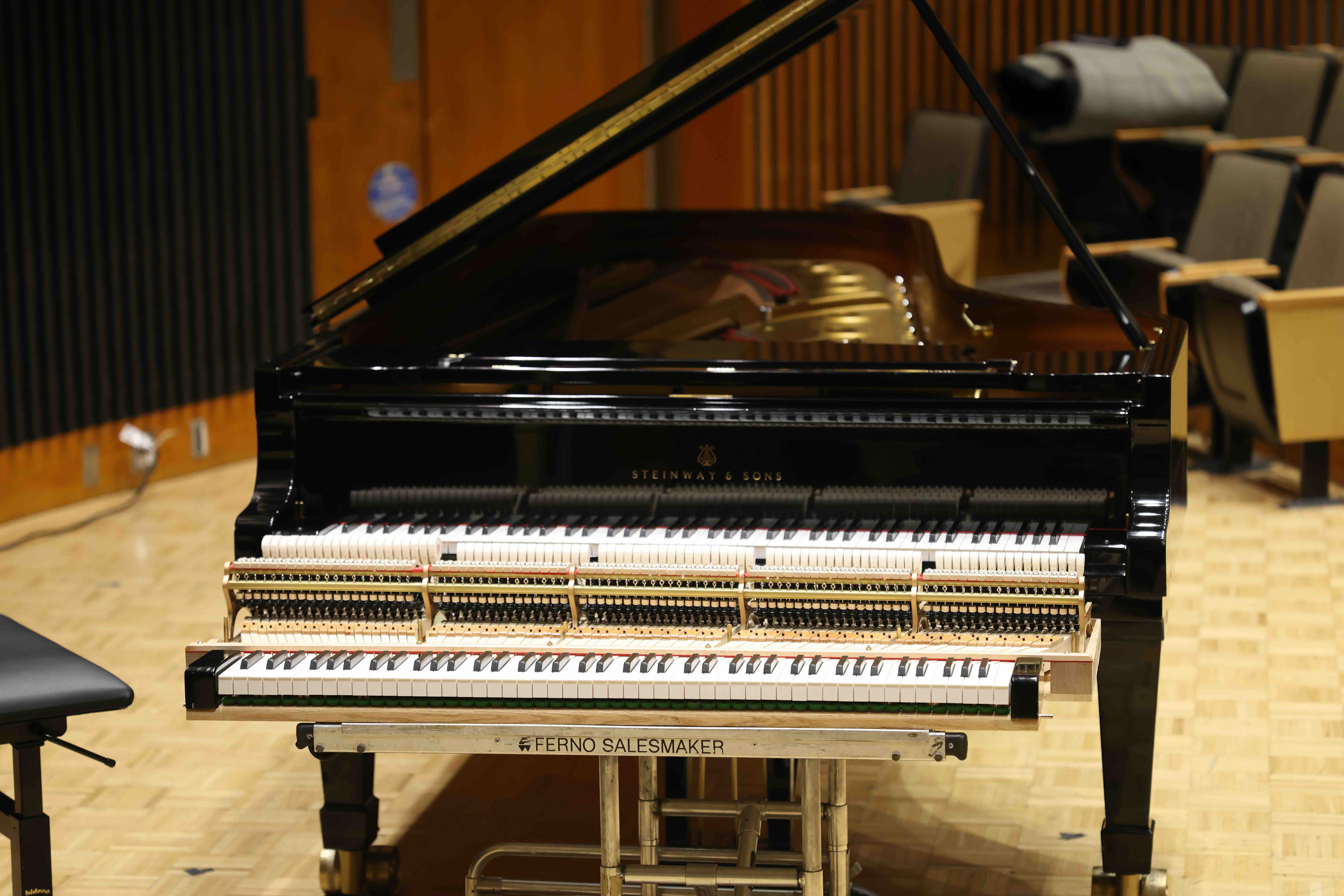
The narrow keyboard (front) and a standard keyboard (behind), showing how reduced key spacing can make the piano more accessible for smaller hands.
A keyboard built for Franz Liszt
The modern piano keyboard was standardized around 1880, when virtuosi like Franz Liszt were becoming international celebrities. As piano design was modified to produce a bigger sound in large concert halls, keys may also have been widened to accommodate the resulting larger instrument. And since the celebrated performers of the era were generally European men, who tend to have larger hands, the wider keys posed little problem for them. At the same time, mass production demanded a standard size to produce thousands of pianos. From this, we inherited a one-size-fits-all, 6.5-inch-octave span.
Before that, buyers could choose a piano the way string players still choose theirs, based on sound and fit. In fact, Polish composer Frédéric Chopin’s own piano was smaller than today’s standard.
“My husband said, ‘Oh, that’s like if everyone had to wear Michael Jordan’s size because they wanted Air Jordans,'” recalled Schumann.
String instruments are made in graduated sizes. Violins, violas, cellos, and basses are all available in a range of sizes, allowing players to choose instruments that fit their bodies. The piano instead remains at one fixed geometry. The consequences may even show up in competition results. Through roughly age 14, young women win piano competitions at slightly higher rates than young men; a similar pattern seen in violinists. Then, for piano, the ratio flips, and men dominate all the way up to elite competitions like the Van Cliburn.

“I felt like I’d been wearing the wrong size shoes my entire life. I genuinely couldn’t believe how much more ergonomic everything felt.”
Measuring the mismatch
The scope of the problem is larger than most pianists realize. A 2015 survey of 473 adult pianists found that only about 13 percent of women have a hand span large enough to play repeated, fast octaves comfortably on the standard keyboard, whereas 76% of men do.
Of the forty-nine students who auditioned for advanced piano lessons at Stanford this fall (most with larger-than-average hand spans), about a third reported being discouraged from playing standard repertoire because of hand size, and almost half have been injured or fear an injury from practice.
“When you’re completely tense, you lose all sorts of capability,” Schumann said. “You lose dexterity; you lose your proprioception.” Pianists playing at the edge of their span tire faster, play worse, and eventually can get injured.
This reality steers smaller-handed students away from the big Romantic repertoire and toward Bach and Mozart. But a narrow keyboard can change that. One of Schumann’s students performed Rachmaninoff’s Second Concerto this year, a piece she said she would never have attempted without a narrow keyboard.
Stanford freshman Annette Lin performs Rachmaninoff’s Piano Sonata No. 2, Op. 36, III, L’istesso tempo, Allegro molto, on a narrow keyboard piano.
Science meets piano performance
Schumann’s team approached the question the way a sports scientist would: does the standard keyboard impose a measurable performance disadvantage on smaller hands?
In the first phase, advanced pianists performed identical tasks, including octave scales, trills, tremolos, and chords, on two versions of the same instrument: one with the standard 6.5-inch octave and one with a 6.0-inch octave. The researchers measured speed, accuracy, and MIDI key velocity, a proxy for force and volume.
The hypothesis was that the benefits of the narrow keyboard would scale with reach constraint and that’s largely what the data show. The biggest gains in force and volume appeared in pianists whose comfortable reach tops out at an octave, with progressively smaller gains for ninth-span and tenth-span players.
“We have seen that there’s a performance ceiling imposed on people with smaller hands because of the standard instrument,” Schumann added. To the team’s knowledge, the study provides the first quantifiable evidence that the standard keyboard imposes such a ceiling.
A second aim of the project asks why these performance differences occur. The computational work is led by Karen Liu, a computer scientist, roboticist, and professor whose Stanford laboratory is developing biomechanical and AI models of the hand and forearm that are designed to estimate joint torques and muscle activation during performance.
Schumann’s network and artistry feed directly into that modeling effort. She brought in the pianists whose movement data underpins the models and helped connect the computational work to the realities of expert performance: 15 elite pianists played in her studio under a camera-based motion-capture system on a MIDI-enabled piano, producing roughly 10 hours of 3D hand-motion data covering more than 150 diverse pieces. The AI model will help provide a deeper understanding of the biomechanics of hand stretch, speed, and force on a piano.
Stanford researchers collected the first large-scale 3D hand motion dataset of piano performance: 10 hours of elite-level playing from 15 pianists, paired with synchronized audio and key-press data.
What began for Schumann as a question about keyboard size has become a lens on design itself. Once she started talking about the work to friends and colleagues, examples poured in from other fields.
“The larger goal is not simply to build smaller keyboards,” Schumann said. “It is to create the evidence needed to advocate for better design and more equitable access to excellence.”
For Schumann, the project also makes a larger point about the role of the arts. “This project offers a different story: that artistic practice can generate research questions, methods, and evidence that change how we understand the body, learning, design, accessibility, and human performance.”
And if a centuries-old instrument within the arts can be rethought, what else can?
This research is part of the Wu Tsai Human Performance Alliance Agility Project Program at Stanford.
Schumann will present the research at the upcoming Performing Arts Medicine Association (PAMA) Symposium on July 26, 2026.
Latest News

October 5, 2026
The exercise showdown: HIIT vs endurance training? A Stanford lab maps the molecular changes
September 8, 2026
A wearable device tracked over 42,000 menstrual cycles. Here’s what researchers found

August 24, 2026
Register for Wu Tsai Human Performance Alliance 2026 Research Symposium
Get Engaged
We invite faculty, students, staff, alumni, friends, and external organizations to participate in the Wu Tsai Human Performance Alliance at Stanford.