
Undergraduate Research Program 2





 Wu Tsai Performance Undergraduate Scholars 2025, Photo Credit: Parker Ruth
PROGRAM OVERVIEW
The Wu Tsai Human Performance Alliance Undergraduate Research Program is an opportunity open to all Stanford undergraduate students to explore the field of human performance through a funded research experience. Students must apply in collaboration with at least one faculty member.
All Stanford undergraduate students are welcome to apply. Students who do not have previous research experience or are from underrepresented groups in academia are particularly encouraged to apply.
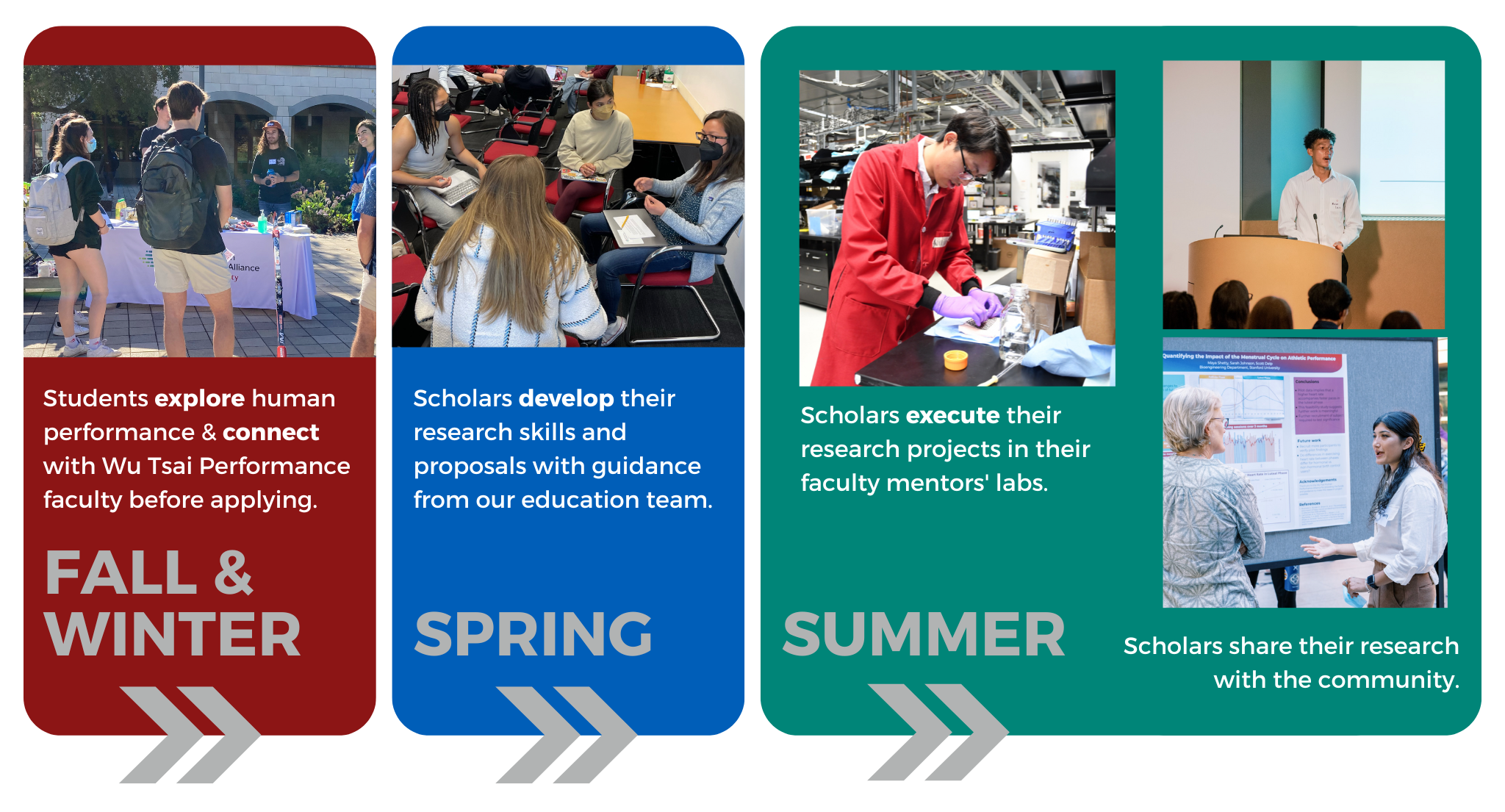
Through the program, students will:
- Participate in the course “BIOE190: Design Thinking for Research in Human Performance” (Spring, Tuesdays 9-10:20AM, no prerequisites) to learn about the field of human performance and the research process, to engage with expert faculty, and write a proposal for summer research.
- Carry out their proposed research with the mentorship and guidance of Wu Tsai Performance mentors as part of a full time, in-person, 10-week fellowship in the summer. See examples of research projects from our past scholars (2022 scholars | 2023 scholars | 2024 scholars | 2025 scholars).
- Join a diverse community of leaders, researchers, and trainees who are passionate about improving human performance and supporting others in entering this field.
Want to learn more?
Join us for an information session or a seminar on human performance and a chance to meet potential mentors.
Are you a program alumnus interested in a second summer of human performance research?
We are also excited to offer alumni the opportunity to return for another summer of research with us. In addition to receiving funding and advancing your career in human performance, you’ll benefit from enhanced teaching, mentorship, and leadership experiences. You’ll also have plenty of opportunities to expand your network across the Alliance and its diverse partners in academia and beyond. The program is similar to your first year, but you will not take BIOE190. Instead, you will get to leverage your experiences to enhance the program and support a new cohort of scholars during the class and the summer. Learn more about the application process below.
Key dates for the 2026 Wu Tsai Human Performance Undergraduate Research Program |
|
| Application deadline | 11:59 pm PT on January 23, 2026 |
| Notification of award | End of February 2026 |
| Program start date | Spring, 2026 |
| Class period | 10-week course, Spring 2026 |
| Funded research period | 10-week in-person research session, Summer 2026, (June 22 – August 28, 2026) with a $8000 stipend |
| Summer Research Symposium | TBD |
A Day in the Life of an Undergraduate Scholar
Experience a day in the life of Stanford undergraduate and Wu Tsai Human Performance Undergraduate Scholar Carly Mae Smith ’23, as she conducts summer research in the Heller Lab.
.
APPLICATION PROCESS
Undergraduate students must agree to participate in all program elements, as listed in the table below:
| Program Element | New Participant | Program Alumnus |
| Two-unit spring quarter course on Tuesdays 9-10:20AM “BIOE190: Design Thinking in Human Performance Research” where they will write a research proposal for planned summer research | X | |
| 10 weeks of full-time (40 hrs/week), in-person research in the student’s host lab(s) during the summer with a $8000 stipend | X | X |
| In-person participation in weekly meetings throughout the summer featuring guest speakers from human performance and research skill workshops | X | X |
| Research symposium presentation at the end of the summer (TBD) | X | X |
Students must be current undergraduates in good standing at Stanford:
- Students may not be on a Leave of Absence (LOA) while using grant funding. LOA Students may apply for funding only if they will return from leave and meet all other eligibility requirements by the beginning of the funded project.
- Students will be eligible for full time project support only in the summer quarter. “Full-time” means that the student’s only major commitment is the project; students are expected to spend 40 hours per week over the entire 10-week period on the project, and are expected to be in-person in their lab.
It is important to find and build a good relationship with your faculty mentor, as this will be the foundation for your research project and could be a lasting connection throughout your career.
CHECK out directory of faculty mentors
- Find a mentor whose research interests align with yours. We have created a directory of faculty who have volunteered to be mentors or who are Faculty Affiliates of the Wu Tsai Human Performance Alliance. You may apply for the program with a mentor not on this list. See “Instructions for Faculty Mentors” on how to do this.
- Reach out to potential mentors via their listed contact. Keep the correspondence brief: introduce yourself, and explain how your interests align with theirs. Ask if they are interested in hosting an undergraduate student in their lab for the summer.
- Set up a meeting with interested mentors. Prepare for the meeting by reading recent publications, news, or listening to their talks. It’s helpful to have a list of questions prepared. This shows you are interested in their work. This is a great opportunity to ask your faculty mentor about potential research projects. There are additional resources available from Stanford Undergraduate Research on developing mentor relationships.
Applicant and their mentor develop a description of a research project that will advance human performance. The mentor also completes a Training and Mentorship Plan for the applicant. The applicant must upload this completed plan as part of their application in SlideRoom.
Submit the following materials through the application portal on SlideRoom.
- Resume (max 1 page)
- Academic Transcript (unofficial is fine)
- Training and Mentorship Plan completed by the faculty mentor. It is the student’s responsibility to provide mentors early notice of this plan.
- See Step 1 above for more on finding a mentor.
- Short answer questions (maximum of 1500 characters or approximately 250 words for each response)
- New Participant
- Please provide a brief description of the proposed research project and how it relates to human performance. We recommend working on this with your faculty mentor. This does not have to be a completely independent research project; it can be a current project of interest in your faculty mentor’s lab. We will help you to craft a research proposal in the Spring course.
- Why are you interested in participating in this program? Include reason(s) you selected your faculty mentor, and if applicable, relevant past experiences and future goals.
- We wish to welcome a cohort of students who have a diversity of experiences and skills. Share something about yourself or your experiences that you feel allows you to bring a unique perspective to the program.
- Program Alumnus
- If working on the same project: Share your project progress since being a Wu Tsai Performance Scholar. How long have you been working on this project? What are the new developments since presenting your work at the Summer Research Symposium? Describe your research plan for next summer.
If working on a new project: Describe the project and why you chose to switch. Include reason(s) you selected your faculty mentor, research project, and if applicable, relevant past experiences and future goals. - Why are you interested in participating in this program again and what do you hope to get out of the program this second time?
- We are always trying to improve our program, and you are an expert and alumnus of the program. Share some of your ideas that could help elevate the program, class, experience, etc.
- If working on the same project: Share your project progress since being a Wu Tsai Performance Scholar. How long have you been working on this project? What are the new developments since presenting your work at the Summer Research Symposium? Describe your research plan for next summer.
Be sure to click “submit” when you have completed your application and look out for a confirmation email from SlideRoom.
INSTRUCTIONS FOR FACULTY MENTORS
All projects supported by a Wu Tsai Human Performance Undergraduate Research Award must be conducted under the guidance of a Stanford Faculty Mentor.
- The mentor must be a Faculty Affiliate of the Wu Tsai Human Performance Alliance at Stanford, or willing to become a Wu Tsai Human Performance Alliance Faculty Affiliate.
- Mentors and/or members of their lab (e.g., graduate students, postdoctoral fellows) are expected to provide weekly feedback on the undergraduate students’ research proposals as part of the Spring class and to meet regularly during the Spring and Summer quarters.
- Mentors will be expected to provide a lab space, desk, and support for the scholar’s research project.
- Faculty should complete and sign the Training and Mentorship Plan and return it to the student, who will upload the plan to the SlideRoom application portal by the application deadline, 11:59pm on January 23, 2026.
- As you create your plan, be mindful that this might be the first research experience for this student. It is important to be thoughtful about how to equip them with the skills to do excellent research, introduce them to your field, and integrate them in your community.
REVIEW CRITERIA
We will review all completed applications on the potential of:
- the proposed research to advance the science of human performance (ensuring the research is focused on performance vs. disease, e.g., not something that would be funded by the National Institutes of Health)
- the proposed project and mentorship to develop deep scientific inquiry and rigor within the student, as well as train and support them for a career in human performance
- the student to contribute to the program’s scholarship, community, and growth
Tips from Past Scholars
100% of our scholars from past years would recommend this program to a friend. Here are some tips from them to you.
- Don’t be scared if you don’t know what’s going on sometimes. You will figure it out.
- Truly invest in this community and make the most out of your time. The Alliance is built to foster interdisciplinary conversations, so use that aspect to explore your interests.
- Get involved in your lab community. Don’t be afraid to ask others besides your mentors for help!
- Connect with other lab members to hear about their experiences.
- Believe in yourself, you’ll progress in your academic and research career along the way. Whenever you fall don’t be afraid to stand back up.
- Don’t undersell your passion or abilities.
- Don’t be afraid to do something wrong, that’s what research is about. Coming in, I was so afraid to mess up or do something wrong. Over time I learned that research is just a process of trial and error, and your support system will be with you the whole time.
LEARN MORE
Join us for a seminar on human performance and a chance to meet potential faculty mentors and our community. We are hosting watch parties (lunch included!) for research talks on cutting edge research from experts in human performance. Following the talks, our team will be available to discuss how to get involved with the Alliance.
Our seminars run 12-1:30pm on select Fridays. See upcoming topics and speakers.
Join us for an info session with our alumni
- November 13, 2025 6-7pm outside the ACSR gym
- Alumni will share their past projects and experiences along with tips on how to make a strong application. We will also take a tour of the Human Performance Lab.
.
FREQUENTLY ASKED QUESTIONS
The sooner the better. You want to give them ample time to get to know you to see if you are a good match for one another, discuss a potential project, and come up with a training plan. We suggest you confirm with your selected faculty member before the end of the Fall quarter.
Almost all of what we know about health comes from the study of disease or injury. The Wu Tsai Human Performance Alliance takes the opposite approach: we are studying peak human performance, with the goal of enabling all people to achieve optimal health and well-being. This collaborative effort brings together multiple disciplines, including biology, psychology, engineering, and medicine to understand and advance human health. We will translate these scientific discoveries into practical approaches that improve the performance of all individuals.
Research projects should be motivated by performance, not by disease, and typically not one that would be funded by the National Institute of Health (i.e., a project exploring the use of a person’s own immune cells to treat cancer would not be funded).
Some examples of human performance research from past scholars:
- Ernest Huang (Data Science ‘27) analyzed the metabolomic responses to endurance training in human adults with Dr. Matt Wheeler.
- Bianca De Los Reyes (Human Biology ’25) worked with Professor Craig Heller examining whether cooling the palms of female athletes could mitigate their fatigue, allowing them to bench press more weight over the eight week study.
- Kaien J-Spencer (Human Biology ’26) spent his summer working with Dr. David Spiegel preparing a study investigating the effect of interventions like hypnosis or breathwork on the brain and stress.
- Bryan Khoo (Management Science ’25) worked with Dr. Kevin Shea creating statistical models to understand knee development in young children.
See examples of research projects from our past scholars (2022 scholars | 2023 scholars | 2024 scholars | 2025 scholars).
Reaching out to multiple faculty will give you a better chance of connecting with a mentor.
Reaching out to graduate students or postdocs in the lab can also be a great way to connect with faculty members and get to know if you are a good fit for the lab.
We strongly recommend working on the brief description of the proposed research project with your faculty mentor. Generally it would be helpful to provide the research question, a brief background on the importance of the question, the proposed method you plan to use to answer the question (likely this will be a method in which your faculty mentor and their lab specialize), an ideal result, and the potential impact on or relation to human performance. Remember this is a brief description (max 250 words), and that you will spend the Spring quarter refining your research proposal in the course with guidance from the teaching team and your faculty mentor, so many of the details will come later.
A strong application will include a description of a proposed research project that relates to human performance. We are happy to help you with this. Email odayj@stanford.edu!
Housing costs are not included in the $8000 stipend.
The BIOE190 class (Tuesdays, 9-10:20am in the spring quarter) is a very participatory and active in-person experience, so we cannot accommodate students who cannot join in-person on campus. It wouldn’t be as full of an experience for you or for the other scholars.
The program orientation will be on the first day of the summer quarter, June 22, 2026 (according to the Stanford Academic Calendar). The program will run for 10 weeks, and students work out details of their research schedule during those weeks with their faculty mentors.
Get Engaged
We invite faculty, students, staff, alumni, friends, and external organizations to participate in the Wu Tsai Human Performance Alliance at Stanford.